By the late 1960s, the Gaylords was a strong force on the Northwest side of Chicago. The paranoia and anger caused from the growing Puerto Rican immigration swelled the ranks of the Gaylords street gang. Which created new satellite sets or spots around the city.
The Gaylord street gang had no official political views at this time. They were just a predominantly White street gang trying to defend their turf in a climatic time.
When the Vietnam War started many members of the Gaylords were drafted in to service for their country. This left the Chicago streets a little more open for street
gangs with mostly black or spanish hertage to spread out and grow.
In the early 1960s, the eviction-relocation of the Puerto Rican community from the Lincoln Park area to the Humboldt Park area, as an act of gentrification by Chicago's political monster-machine, generated anti-American sentiment. Of course, anti-American sentiment was already seeded in the Puerto Rican community, early on, by events that occurred in the home country. America had enforced martial law in Puerto Rico after a 3-day revolt that was inspired by radical nationalists. In that particular militant street-uprising that began on October 1950 America's industrial-interests were viciously attacked. An insulted America repaid the conflicted commonwealth in kind by sending in troops and blasting off bombers, against Jayuya and Utando, Puerto Rico's points of interests. The uprising was eventually suppressed. Incidentally, on November 1950, two nationalists tried to assassinate President Harry Truman and failed; Griselio Torresola was killed during the attempt and Oscar Collazo was captured. Ill-feelings were not squashed there, the nasty nationalists thought they would have another go at America by using the U.S. House of Representatives for gun-target-practice on the actual anniversary of Puerto Rican citizenship.
Now, people might wonder why Puerto Rican nationalists or those having anti-American sentiment would immigrate to America, a country that they viewed as horribly oppressive, but they indeed did. Sure, thousands of respectable Puerto Rican people immigrated to America with wondrous hopes of a prosperous life, but embedded with in that influx were the ultra-infuriated. In Chicago, by the early 1960s, self-labeled-guerrilla gangs are spawned and ingrained in the Puerto Rican community. They propagate all out disdain for anything pro-U.S.A.
With their revolutionary script and defiantly painted Puerto Rican flags, mural to city walls, the Young Lords are key figures in pushing for a revolt. Another group supporting this radicalism is the brewed-up Latin Kings. When Chicago's political monster-machine grinds out the disturbing eviction-relocation of the Puerto Rican community, it is easy to understand the seething resentment. However, this process has occurred before with other cultures without any discord developing; such as the displacement of the Italians when the housing project of Erie Cabrini Green is erected. But, when this occurs with Puerto Rican community, the ingrained militant-minded become an explosive-bomb with a fuse ready to be lit. And the fuse is lit.
Chicago 1966 Division Street Riots
On June 12, 1966, during Chicago's first Puerto Rican Day Parade the Division Street Riots ensue after a police officer shoots 20-year-old Aracelis Cruz because the officer said he observed Cruz with a gun. Puerto Rican gangs are the spear-headers for the rioting. After the deployment of over 50 squad cars and finally the National Guard the riots are dissolved. Not dissolved are the newborn haters for the American Flag and the Chicago Police badge, which come forth from out of the prideful Puerto Rican Community at different levels. The Puerto Rican gangs feel even more empowered by the highly politicized activity and they feel licensed to move forward at hyper-drive with their corrupt conquerization of neighborhoods. In 1960, the Puerto Rican populace numbers were at around 32,000. By 1969 it has now more than double to close to 80,000, and this is not including the heap full’s of illegally immigrated. Churned out of all this Puerto Rican immigration have come the deformed births of more Puerto Rican gangs: Haddon Boys, Disciples, Dragons and others. Primary movers such as the Latin Kings have crowed new corners and continue to expand: Cortez and Whipple, Whipple and Cortland. The Kings are also absorbing up other gangs; Hirsch Street Lords have merged with the Latin Nobles to become Division and Spaulding Latin Kings.
When the Puerto Rican gangs first touch down, it was not some glorious Neil Armstrong moment for the surrounding areas. The habitat-altering event starts a drastic domino effect, where fearful residents start racing off in what becomes a mass exodus for two decades, at least. Those who are financially unable to secure a ticket to White Flight out are screwed; time to secure all the locks on the doors and peak out the window and watch the neighborhood deteriorate. Those that are really left to fend for themselves in the mayhem are the youths, whites and other Americanized teenagers. Any plans for the grand ole' American Dream are put on hold or erased from the scratch-pad entirely as these youths slip into survival mode. Simply going to places like Wells High School or out on a meager mission for a loaf bread becomes a cultural-contest for ones life. During this whole entire process, there are agitated anti-bodies that go right to work securing their neighborhoods and creating deflecting pockets: white gangs; Playboys, Chi-West, Ventures, and others. And the only base of Gaylords on the North side, undaunted Grand and Noble. These white gangs have ruled supreme for years as greaser-giants since the 1950s, simple humbugging, and now they are banging ballistic ally with a flood of militant-minded Puerto Rican gangs as the entire Puerto Rican community outflows from the Lincoln Park area, pretty much the Windy City's lakefront, and treks 12 miles west to Humboldt Park. During this almost decade-long Puerto Rican pilgrimage, basically down Division Street, hyper-viper Puerto Rican gangs sprinkle out and seed along the way. And they rapidly grow like cancer cells. Since Humboldt Park is the destination spot, clusters of seedy Puerto Rican gangs have started mutating there also. Puerto Rican gangs are not just starting up street corners for themselves. They are inspiring others to do so also.
Logan Square: Palmer Street Heads
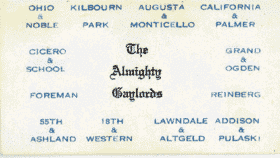
One group of youths, the Palmer Street Heads, a ruffian party clique, was feeling the immediate threat. Poverty stricken Palmer Street, just off of Palmer and California, where the Palmer Heads had carved out their psychedelic-experimenting-existence, had found itself just five city streets from the volcanic gang activity. Latin Kings have larvaed right up. Neighborhood daily living had becomes a daily scramble for survival. Not just the teenagers, other residents are paranoid about the building cultural tension. And in 1969, in search of an answer to avenge themselves against hood hostility the Palmer Street Heads caught the fascinating Gaylord vibe from the Kilbourn Park Gaylords, who had actually just been established themselves that same year. Becoming actual Gaylords is a no-brainer for the hazy-headed Palmer Street Heads. It is time to officially become something to deflect the hordes of Puerto Rican gangs about to stir up their little echo system. They are energized by the timely transformation as it not only gives the group a reputable name, Palmer Street Gaylords; it provides them with marvel team ups. When the Nationalistic Puerto Rican gangs need to be strongly check mated other Gaylords, from other hoods, steam roll through to asset the assaulted island. As the Puerto Rican gangs progressively tighten up around their shrinking pocket the Palmer Gaylord dig in deep and become brazen-battlers.
Logan Square: Lawndale and Altgeld
Palmer Street is not the only new protective-product that comes off the Gaylords' line that year. The Lawndale and Altgeld Gaylords have organized because the neighborhoods' astute youths feel the oncoming title wave of Puerto Rican gangs is close at hand. The reality comes sooner than they think. The Imperial Gangsters, a newly spawned Puerto Rican gang, has beached-up just 4 city streets from the Gaylords' nest egg. With that, the area high school, Kelvyn Park, is starting to show a rapid increase in Puerto Rican gang attendance, as others youths white flight out. The Gaylords are determined to hold native ground----The American Dream. The Lawndale and Altgeld Gaylords are just over a mile west from the Palmer Street faction of Gaylords, and these two pockets will eventually become battered bastions. In all actuality, these two groups of Gaylords slow the White Flight in the area to some extent as residents feed off the security blanket that the Gaylords provide by keeping the Puerto Rican gangs at bay.
Old Irving: Kilbourn Park
Like the Palmer Street Gaylords, the Lawndale and Altgeld Gaylords have been christened by the Kilbourn Park Gaylords. Now, Kilbourn Park dose not even have the same zip-code-connection as the other Gaylords sets, the culture-clashing crash sight. Stout-hearted members of Kilbourn Park have met the travelers of the turbulent hoods through intermixing at high schools, and the Gaylords' fascination has been torch-passed on from there. Kilbourn Park itself is fortified with Gaylords. Back in the 1960s brawny Gino, a Gaylord guru, moved into the modest neighborhood, all the way from the only set of Gaylords on Chicago's North side at the time, Grand and Noble. And charismatic Gino transplanted Gaylord heritage and pride into the hearts and minds of area youths. In no time at all there is a Gaylords' depot at School-n-Cicero. From there they start eye-balling the greenery of Kilbourn Park and decide to physically evict the Popes, a greaser gang, and take up occupation, which they do with an easement. For sure, the newly throned Kilbourn Park Gaylords have the occasional humbugs with other area gangs, traditional head-splitting to secure their reign, but essentially everyone is on high alert due the Puerto Rican gangs. All though offshore from the main beach head Kilbourn Park Gaylords are still having contested run-ins at Schurz High School and other public venues.
Grand and Noble
With their hood boundaries just 8-city-streets from wilting Wells High School, where whites and others were un-enlisting at sonic speed, the seasoned Grand and Noble Gaylords are in the middle of a feudal firestorm. Their weathered pocket is being stampeded over by all the Puerto Rican migration moving on towards Humboldt Park. In the process Puerto Rican gangs are smothering the streets around the Gaylords. Gangs such as the Latin Kings have gained a foothold and it has been murder and mayhem. Incidentally, while Kilbourn, Lawndale, and Palmer Gaylords are being established in 1969, a Latin King member, Juan Rivera, has been shot and killed by a Gaylord by Grand and Noble. The Latin King had moved deep inside Gaylords territory, which caused explosive friction. With that, a police office has shot a Gaylord in another situation. The area is going through a violent culture clash where one will be up heaved. After over 16 years, the weary Gaylords will have no choice but to move out and on, saving their families. While the underdog flagship of the Grand and Noble Gaylords is sinking other ships set up sales.
Reinberg School
Other Gaylord sets sprout up like Reinberg School where Gaylord ideology had become a treasured commodity at the neighborhood bowling alley, Manor. Even farther inland then Kilbourn Park from all the Humboldt Park hostility this bright handful of youths still feel the need for protective protocol by organizing an actual Gaylords' section in a their modest neighborhood that centers around the clean-cut grammar school of Reinberg. And, maybe the lads are not far off in their rationality here, as one of their members, 14-year-old Harpo, is murdered by a gang that empties out on him from a night-creeping-car in his docile hood. The culprits turn out to be the minor-league K-Town Lords. K-Town is adjacent to the left of the Humboldt Park area. K-Town Lords will completely evaporate after the murder; rumored that their main members get adopted by the Latin Kings.
Back of the Yards and Pilsen Gaylords
55th and Ashland18th and Western
Gaylords have some real estate on Chicago's southside:18th and Western, 55th and Ashland. But the darkly curtains will soon closing down there, just like they are at Grand and Noble.
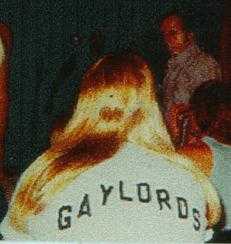
Chicago's political monster-machine is not doing for them, so the Gaylords are doing for themselves. In the urban jungle everyone is defending the preservation and propagation of their own kind. Numbering over 300, Gaylords see themselves as minute men of their neighborhoods. Outsiders might not understand the deranged crosses that are being paint-pushed to city walls by Gaylords, but it is a crusader-ish act. Along with being cross-carriers the Gaylords are knitted-knights. Just like most gangs they style their crafty collegiate sweaters, a serious representation of customized colors. Their main mission is to expel and repel any of the hood-decimating Puerto Rican gangs---the assimilation angry.
The Puerto Rican gangs are assimilation-angry, as they flauntingly plaster their shirts and urban-filthy walls with waving Puerto Rican flags. On Chicago's streets this flag becomes a symbol that was being grenade-tossed at the American way of life by the Puerto Rican gangs who viewed it as a oppressive system. But, lots of Chicago's inner city was suffering economic and racial hardships, which included thousands upon thousands of whites. Rallying cries of abuses administered by the Chicago Police to poor Puerto Ricans is also not a explicit category. Whites, Blacks and other street dwellers all suffer the same.
1970Gaylords
Chicago Young Lords and Latin Kings
By 1970, separating themselves from the other gangs, the revolutionary Young Lords have taken the political-agenda trail, seeking to try and squash social injustices for the Puerto Rican people. However, the rest of the Puerto Rican gangs have asphalt-aspirations. Incredibly, the Puerto Rican gangs have even decided to add more solidness to their corrupt constitution by calling on all Spanish and Latinos to join the street struggle, in the oppressed system of the skyscraper city that they have all flocked to on their own accord. And Hispanic hookups are made. Mexicans, and other fast immigrating Spanish, either add their allegiance to the Puerto Rican gangs or creature-create their own gangs. And as this collective struggle unfolds there are some mishaps. The recruiting-robotic Latin Kings alienate some Spanish youths by their strong arm tactics, and the youths rebel by organizing their own monarchy, the Imperial Gangsters. The Imperial Gangsters are opponents to the other thrown-adorned gang for decades. The Latin Kings also manage to kill a Spanish orchestra band member and the grieving band does a wacked-out wardrobe change and becomes Orchestra Albany. And they are Latin King haters for life also. It is all tribal tragedy in the urban jungle as the Spanish gangs make their conquests. But then again, there are the white gangs Tarzan-swinging on in.



 18th and Western
 Gaylords